

Ottawa Mortgage Blog
Your Trusted Ottawa Mortgage Experts
The Power of Leveraged Investing: How Leverage Turns a 4% Gain Into a 20% Return
October 5, 2026 | Posted by: Jamie Small - Ottawa Mortgage Broker
Your rental property increased in value by 4% this year. So you earned 4% on your investment, right?Not even close, if you've borrowed to buy your property. If you purchased your property with a mortgage, your real return could be five times higher. That's the power of leverage, and it's one of the most misunderstood ideas in real estate investing.
Let's walk through a real-world example, step by step, so you can see exactly where the money comes from.
The most common mistake: measuring against the purchase price
Your return should be measured against the money you actually put in, not the price of the property.Here's our example property:
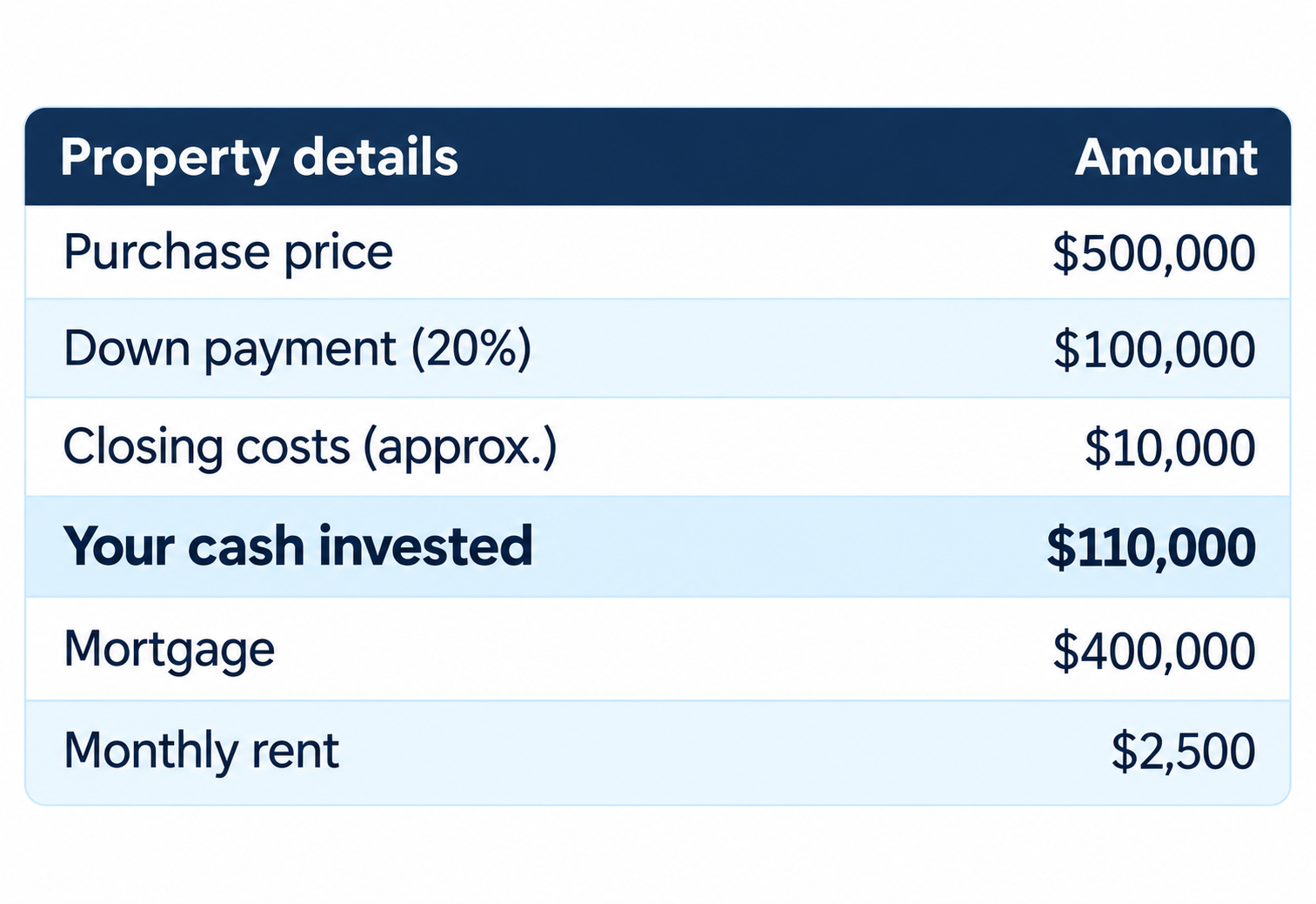
The bank funds the other $400,000, and your tenant's rent pays that mortgage. Yet you own 100% of the property, and 100% of its growth. Keep that $110,000 figure in mind. Every return below is measured against it.
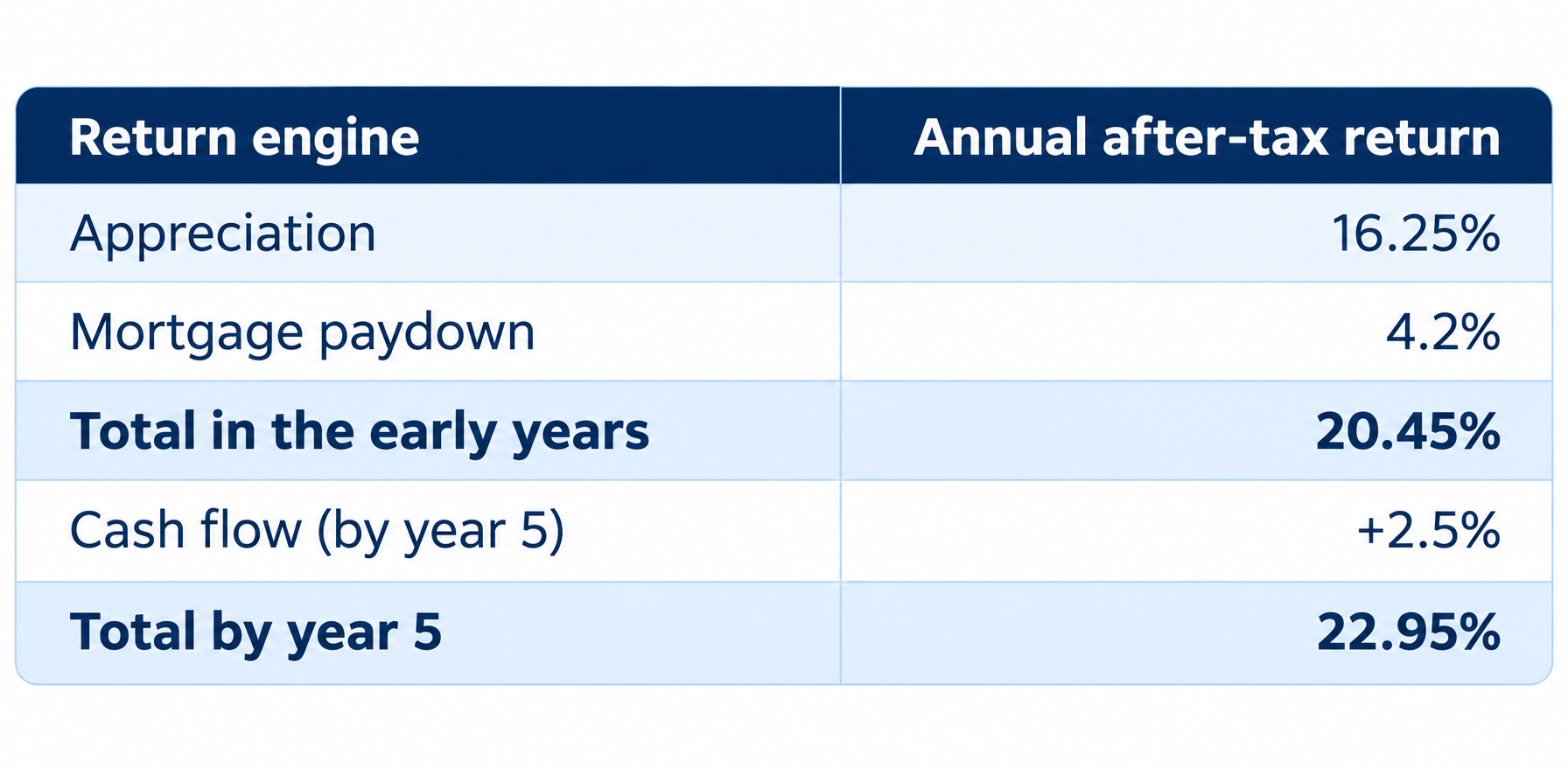
Engine #1: Appreciation — a 16.25% after-tax return
At 4% annual growth rate, a $500,000 property is worth about $608,000 after five years. That's an average gain of $21,665 per year.Measured against your $110,000, that's a 19.7% annual return, from appreciation alone.
Of course, the taxman gets a share when you sell. In Canada, half of a capital gain is taxable. At a 35% marginal tax rate, that's roughly $3,791 per year on average. After tax, your appreciation return is still about 16.25% per year.
Quick tip: we've been conservative here. Canadian home prices have averaged closer to 5% growth a year over the last 30 years.
Engine #2: Your tenant pays down your mortgage — another 4.2%
Every rent cheque chips away at your mortgage principal. That's equity building in your name, paid for by someone else.On a $400,000 mortgage, roughly $7,119 per year goes to principal in the first five years. Rental income is taxed as regular income, so at a 35% rate you keep about $4,628. That's another 4.2% return on your $110,000.
And this engine speeds up over time. As the balance shrinks, less of each payment goes to interest and more goes to principal. In years six to ten, this return grows to about 5.2% per year, with the same rent.
Engine #3: Rising rents and positive cash flow — another 2.5%
Rents don't stand still. If rent rises 2.5% per year, your $2,500 grows to about $2,828 per month by year five.Your mortgage payment, meanwhile, stays the same. The difference is roughly $350 per month of positive cash flow, or $4,200 per year. After tax, that adds about 2.5% to your return.
Adding it all up
Leverage vs. paying cash: the side-by-side
What if you'd skipped the mortgage and paid the full $510,000 in cash? Same property, same growth, same rent.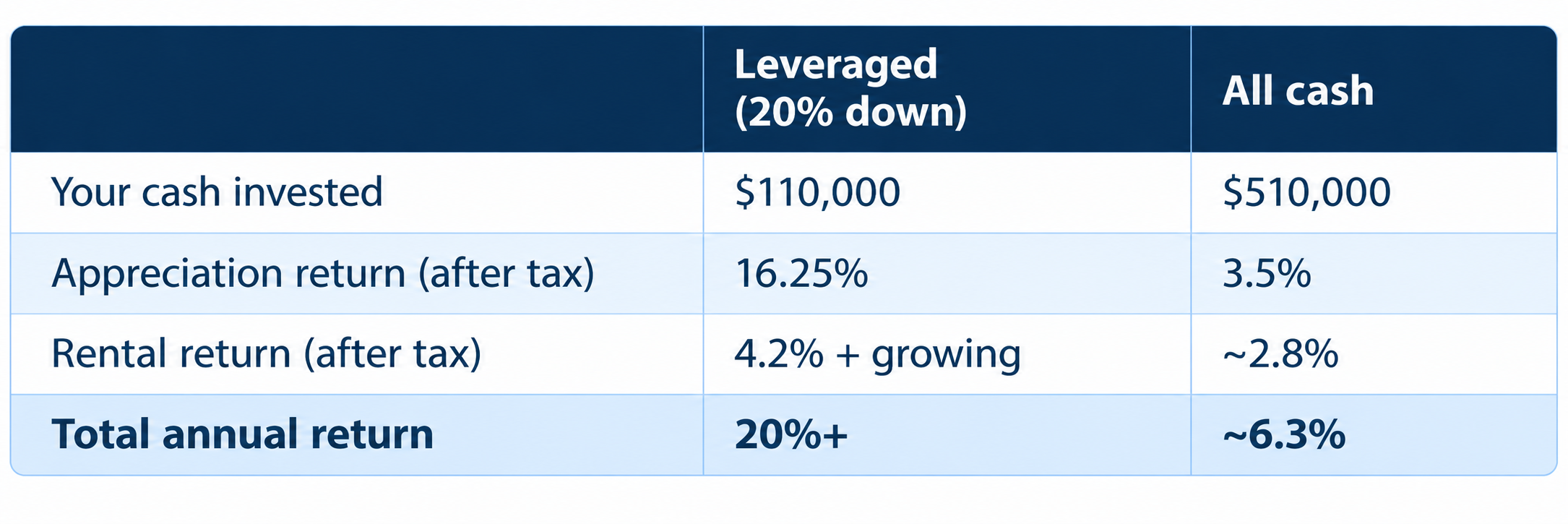
Same house. Same tenant. More than three times the return, and you still have $400,000 free to invest elsewhere or keep as a safety cushion.
Leverage cuts both ways: what to watch
Leverage magnifies gains, and it magnifies losses too. Smart investors go in with eyes open:• Price drops hit harder. A 10% decline on a $500,000 property wipes out $50,000, nearly half of your $110,000.
• Vacancies and repairs happen. Budget for property tax, insurance, maintenance and empty months, not just the mortgage.
• Rates change at renewal. A higher rate can shrink or erase your cash flow, so stress-test your numbers.
• Real estate isn't liquid. You can't sell a bedroom when you need cash. Keep an emergency reserve.
The right mortgage structure makes a big difference to all four. That's where a good broker earns their keep.
Is leveraged investing right for you?
For many Canadians, a leveraged investment property is one of the most effective ways to build long-term wealth. It can help you:• Build a retirement nest egg that grows while tenants cover the costs
• Create wealth to support your family
• Fund your children's education down the road or help them to purchase their own home
The key is getting the financing right from day one: the right down payment, amortization, rate type and term for your goals.
Ready to run the numbers on your first (or next) investment property? Book a free, no-obligation call with us and we'll show you exactly what leverage could do for you.
This article is for educational purposes only and is not financial, tax or legal advice. Figures are illustrative and based on assumptions (4% annual appreciation, 2.5% annual rent growth, a 35% marginal tax rate, and rent that covers the mortgage payment). Actual results will vary, and real estate values can go down as well as up. Speak with a licensed mortgage professional and a tax advisor about your situation.